Pages

Showing posts with label leadership. Show all posts

Wednesday, December 28, 2022

Can't Stop Talking About It


 I'm doing a series of short posts during the holiday break. 

What does your conversation in and out of the classroom reveal about your passions? Students hear the one and your colleagues hear the other. What would they say you get excited about?

I remember long ago my students told me they could avoid a quiz or homework in Spanish class if they just asked their teacher about her time in Spain. She'd get so excited, she'd talk to the end of the hour.

I have never been one to spend lunch in the teachers lounge regularly. When I do find myself there, I love it when I can share a conversation with a teacher about an exciting activity she did or that she plans to do. Sure, we all need those conversations that have nothing to do with the job, but it's great to see passion for teaching spilling into what most consider work-free time.

And what conversations never come up in those settings?

Our heart's passions overflow into our words. What drives us and what's driving those around us can be heard behind the surface chatter, if we stop to listen. In a job as important as teaching, it's imperative that we as leaders (leaders of buildings, leaders of classrooms) take the time to hear hearts behind the words.

Thursday, December 22, 2022

Creating Culture - New Insight

I'm doing a series of short posts during the holiday break. 

Artists create. Some paint pictures or compose music. Some (probably not thought of as artists) work on the canvas of daily life. They intentionally shape the culture of their environment.

When I'd talk with district leaders about staff or students, or my brother who pastors a church, I used to say the following when it comes to leadership and culture. 

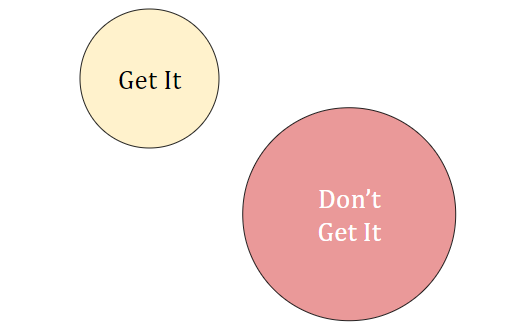
Think of people in your organization who "get it". Don't worry too much about what it means to get it. Just think of a few of them. You know who they are. Then think of the group of people who don't get it. Maybe they're a much bigger group, maybe not.

So the big question I always posed was:  Q1:  What do people in the Don't Get It group see and hear regularly that makes them feel it's important to move to the Get It group?

The key words are see, hear, regularly and feel. Feel is probably most important. Without using the terms, this is really touching on the (possibly unspoken) core values of the organization. It addresses messaging and mission.

But lately I realized there's another side to this--another question that must be addressed. It's just as important to also consider Q2:  What do the people in the Don't Get It group see and hear regularly that makes moving to the Get It group feel like too much work?

See, a lot of people don't live up to their potential because they're convinced other people and circumstances will undo their hard work. They might not state it this way, but that feeling is a culture drain. It's drag on the vehicle in the race toward greatness. 

If you're not sure what the energy killers are in your organization, just listen to the people most comfortable in the center of the Don't Get It group. Those people love to point out what's holding everyone back. They chant them in grumbles, wrapping themselves in "why bothers" like cozy blankets. 

You will never eliminate all the possible answers to Question 2. Instead, the task is to move forward despite the resistance. In other words, make sure your answers to Question 1 are more pervasive in the organization than the forces uncovered by Question 2. Like strokes on a canvas, make it happen one small win at a time.

Friday, April 6, 2018

Excellence in Education Award

This is a post copied from my Classroom Games and Tech blog.

I've been wondering if I need to trim back on the extra work I do in education, then I was notified recently that I won the Excellence of Education Award from the Michigan Lottery.

The honor brought with it some interviews (one on camera, which is part of the video below) and some soul searching. It has been a great honor and a chance to sort out what I've done right over the past two decades. It's given me much to consider as I plan the rest of 2018.

Candidates for the award are nominated by students or staff members from their district. In my case Melinda Newcombe nominated me. Melinda is a high school English teacher I've worked with for a long time now. She will tell you I immediately questioned her judgment when I found out I won. I eventually decided it would be better to go with it than offend her!

I decided two things if I was going to accept the award. First, I have to give God credit if I have ever done anything right in education. Teaching has been an uphill struggle for me, especially those fourteen years trying to teach high school math. While some of it fit my personality, a lot of it certainly did not. I decided teaching is a calling and I stuck with it. I learned to pray about it and trust I was where I was supposed to be. 

My book for success would have two chapters--Trust God and Marry Well. I don't know much after that.

Second, I hoped this would bring some positive attention to our district. I work with many excellent educators, many better than I could hope to be and many who helped me be better. 

The only reason I would get recognized over them is because I work with so many more teachers and students. It increases my chance to be noticed. If I had to pick one of them to nominate, I honestly don't know how I could ever choose between them.

As anyone in education will tell you, good teachers make tremendous sacrifices for their students. I see many at LakeVille doing that every day and this has been a reminder to do better at highlighting their successes.

If you're interested in seeing the announcement for the award, it's here.

And here is the video as it aired from one station. (Note that they put the wrong name on the screen for the person who nominated me. I made sure it was corrected at other stations, but their videos weren't so easy to embed.)


Tuesday, October 27, 2015

Balance Is Overrated

People generally strive for balance in their lives and I know there's wisdom in that. Moderation has its place. Still, we do not live in isolation. In an organization, a bunch of "balanced" individuals might not be what's best for the overall purposes of the group.

It can result in a group that's very out of balance in significant ways.

It might require a very out of balance individual (in some sense) to right the community. 

I'm not talking about that odd uncle who keeps the family gatherings interesting, even though his life is out of control. I'm talking about stepping out for what you believe in because it needs to be noticed.

I've written a lot lately about my colleague and friend Jake Gentry and our recent inquiry-based lesson. He goes out on a limb sometimes to try something new for his class. It takes more work than doing just what he did the year before. When he shares what he's doing with other teachers, he loses some social points with those who like to keep business as usual. Heck, even I tell him to tone it down sometimes.

But it's been exciting working with him. I see how it benefits the students. A couple weeks ago he gave me a high-five after we looked at survey responses. That doesn't happen in most classes!

Reasonable risks and extreme measures on the part of individuals can bring life back to the group.

What radical steps could you take to tip the scales back toward excitement in your school?

Friday, October 23, 2015

Life as Art

I've been writing a lot about The Way of the Artist in this series. I sum it up in the three "not so simple" steps:

  1. Dream big
  2. Do the work
  3. Share it
My point is that as the dream transitions to reality and people are touched by it, inspiration happens. The artist is inspired and so are those who enjoy the work.

We can think of any project as art in this way. Maybe it's something we'd normally consider art, like a painting or a song, but it doesn't have to be limited to those things. 

My wife helps run a homeless shelter in our community. She could talk about the initial vision, the work it takes to make it real and how the end result is shared with those in need. I call that art too. People are inspired to take part in it.

But what if we go beyond projects and look at our lives as art? Or if not our entire lives, how about roles we play such as teacher, father or husband? I think there is great value in reflecting on ourselves and our actions in this way.
  • What was the initial vision that got us in this role? Was it our vision, someone else's or a combination of many? The power of the final work starts in the uniqueness of this original vision, so it's worth exploring.
  • What work did we do to make that vision a reality? How close have we come?
  • How are the results of this vision and work being shared? It might be shared with only a few people, but my guess is there's a way in which it can inspire.
Of course, when our lives is the work, we almost always talking about a work in progress. It is a special type of art that's never done. It's like a song that changes as many people play it or a long-running play that develops over the years.

There's always a chance to get closer to the vision (or maybe alter the vision). There's a chance to share it with more people or share it in a better way. 

I encourage everyone to think about life this way, some aspect of it, some ongoing work you're involved in. Look long and hard at it. Connect with the original dream and do what it takes to make it real. Tell the story and stay inspired to inspire others.
_________________

I'm doing a challenge this month to post on one of my blogs every day. It's in preparation for my conference session, The Way of the Google Drive. Be sure to follow me on Twitter or on either blog to keep up with the "thoughts and tools to inspire". 

Click here to see all the posts from Teaching Like an Artist with the tag The Way of the Google Drive.

Monday, October 19, 2015

How I know we're doing something right

Five things I see or hear from students that help me know we're on the right track:
  • Real questions that reveal curiosity or a desire for understanding
  • Excitement to share what they figured out
  • Excitement to show what they made
  • Hard work without anyone mentioning grades
  • Sincere thanks for helping them along the way
What else could we add to the list?
_________________________

I'm doing a challenge this month to post on one of my blogs every day. It's in preparation for my conference session, The Way of the Google Drive. Be sure to follow me on Twitter or on either blog to keep up with the "thoughts and tools to inspire". 

Click here to see all the posts from this blog with the tag The Way of the Google Drive.

Sunday, October 18, 2015

Finding Your Place

When I talk about The Way of the Artist, it's easy to see it in terms of the students' work and the teacher's work. Maybe it's a class project the students dream up. Then work on it and share it. Maybe it's the work of art is the lesson or activity that the teacher created.

But on another level, we can look at our very lives as the work of art. Day by day we move closer to a vision of what we could be. We do the work and, hopefully, we share the story.

With any creative work, it is fascinating to me how that initial vision develops in the artist's mind and makes its way into reality. It's more fascinating to see how my life or periods of my life, such as my career or my marriage, emerged from that journey over the slow passing of time.

We set out with a picture in our mind of how our lives will look. We work for it, adjust to frustrations and surprises of what real life hands us and ultimately end up as we are, where we are.

It's worth taking a long look at ourselves from time to time, to see how close or how far we are from the initial vision.

Like almost anyone, when I graduated from high school nearly 30 years ago I had some big dreams. The big ones were to make movies and to play in a rock band. Over the years I moved close to and far from those goals. I even gave up on them more than once, but I or they would eventually circle back again.

It was amazing to me last year when I stopped to think about those dreams and I realized how much my music and my desire to make movies had crept into what I was doing almost daily. I still play music nearly every week in our church. I work at the high school and middle school directing and editing as I help the students complete video announcements. 

Had I seen myself doing those tasks 30 years ago, I certainly would have said they were not what I had in mind. Where is the glamour and fame?! Still, I find it rewarding now. I don't think I gave up on the dream and settled for less. I'd say instead that I found my place. 

The dream was important, but there was more to it I didn't know. Finding that "more" and being grateful for it is the gift of seeing life as art.

Our lives are the ultimate work of art. They are a collaboration with chance, other people and (as some of us believe) with God. We can't see the end result or know fully what it is we should become. We get hints though, through our passions, talents and dreams. 

The trick is to keep working at it when it's tough and to know when to let go. Sometimes the specifics of our dreams just aren't meant to be.

Wherever we end up, whether close to or light-years away from our original dreams, it's important to marvel at the art of it and to be thankful for it. It's important to share the vision and the end result with others, so they can see art unfolding in their own lives.
_________________________

I'm doing a challenge this month to post on one of my blogs every day. It's in preparation for my conference session, The Way of the Google Drive. Be sure to follow me on Twitter or on either blog to keep up with the "thoughts and tools to inspire". 

Click here to see all the posts from this blog with the tag The Way of the Google Drive.

photo credit: Throwing 4 via photopin (license)

Thursday, October 15, 2015

Step by Step

I've been going to school in one way or another for over 40 years now. I think there was one September in the past four decades where I didn't start school again, either as a student or a teacher. In the class or in front of it, I've tried hard to pay attention to what's going on.

One thing that's becoming clear to me after all this time is how each step in our work--each assignment, test, professional development session or evaluation--is only part of the long journey of learning. It's never just the task at hand, as if we're done with it and we got what we needed. Every one of them is an investment for something later. It's value can be missed without reflection during and after the work.

In my job I'm often helping teachers with technology. I realized at one point the ones who struggle the most with tech tools are the ones who think it is about the particular project we're doing. It's like when I'm helping them edit a video, they think the goal is to have a finished video. At first it can take way too long to make one video. Was it really worth three hours to get those 30 seconds?

And even after all that time it might turn out bad or the tech doesn't hold up for us. Maybe we couldn't finish it in time at all.

Of course the finished video is important. Not having a good one might have negative consequences. But in education, the trick is to remember there are at least a hundred other things going on for further learning (ours and our students').

In this example, when we realize the real goal is to develop digital literacy so that we can help hundreds of students over the course of our careers, suddenly a few setbacks and unmet expectations are not complete failures. Important lessons were learned. We took a step toward the real goal even if the task in the moment ended with some frustration.

Could we really imagine we'd inch along such an enormous, important journey with anything less than some periods of pure work?

And when we try, yet fail in the short term, it's not so bad when we realize it was at least a step in the larger journey. To not try was to only stay where we were. If that's not wrong in how it affects us, it certainly shortchanges the students we will teach.

To see these possibilities that lie before us, this endless road of repercussions, is both encouraging and overwhelming at times. It is a  journey that we'll never really complete. It's important to get as far along as possible, though, because it's the only way to catch a glimpse of what could be.

Just seeing it from afar, somewhat clearer today than yesterday, is a gift.
_________________

I'm doing a challenge this month to post on one of my blogs every day. It's in preparation for my conference session, The Way of the Google Drive. Be sure to follow me on Twitter or on either blog to keep up with the "thoughts and tools to inspire". 

Click here to see all the posts from this blog with the tag The Way of the Google Drive.

photo credit: Forest via photopin (license)

Saturday, October 10, 2015

What We Could Be

The key to lifelong learning and personal development is to be more excited about who we could be than who we are right now.

I work in leadership in a school district and in a church. In both places we deal with personal growth and learning. Whether we are leading 5th graders, staff or retired adults, the challenges are the same.

When we present to someone an opportunity to stretch, or in a bigger way, to be transformed, excuses are quick to follow. It's similar to asking someone to pack up their belongings and move to a new state. Or maybe it's a weekend stay in a nearby city. It wasn't in the plans and even if it promises some benefits, suddenly the way things have been sounds good enough.

Our lives are busy. The many pleasures and pastimes of our society, that break up the routine and give a semblance of change, offer more than enough distraction from the vision of what we could be. We are consumed with what we are and what we've got on the schedule for the near future.

Our resistance to change is a retreat to comfort in what we are and the world we know.

  • "I'm not really into...."
  • "I'm too busy to...."
  • "I tried that once and now I know...."


    On the other hand, an openness to opportunities is focused on who we could be or how life could be for others. If there is comfort in the moment, it doesn't compare to the promise of possibilities ahead. This requires a shift in thinking and often a herculean effort to resist the pull of our culture.

    There are other factors too, of course. Perhaps change is easier for some because there isn't comfort in the moment. And there also can be a sense of responsibility. Sometimes we plunge in, leaving comfort behind and dreading what it will make us, but we feel it's something important that we must do.

    To get practical, though, what does this mean for us as teachers and leaders in education? 

    Consider the benefit of highlighting the stories of transformation. In church we call those testimonies. Let the people who have grown the most talk about the experience. Lift up the promise that we could all be something more than we are now. Open doors of opportunity to those who are willing to step inside, then ask them to share it with the group.

    Publicly value personal growth as if it were more rewarding than a family trip to Disney. Because it is. It's not without tremendous cost at times, but it is worth it. If the leaders among us are living it, the community will begin to believe it.
    _________________________

    I'm doing a challenge this month to post on one of my blogs every day. It's in preparation for my conference session, The Way of the Google Drive. Be sure to follow me on Twitter or on either blog to keep up with the "thoughts and tools to inspire". 

    Click here to see all the posts from this blog with the tag The Way of the Google Drive.

    Sunday, October 4, 2015

    The Two Levels of Engagement

    When it comes to online content or your PLN, are you operating at Level 1 or Level 2? Let me explain.

    I remember about nine or ten years ago hearing someone talk about the second generation of the internet. They referred to "Web 2.0". I had been online for over ten years at the time, quite comfortable with building webpages and taking advantage of all that the technology had to offer. I remember wondering how different this new internet would be and what it would require me to learn.

    Then several years later I actually had to look it up. What exactly did come along with Web 2.0? I sort of adjusted right along with it and missed what that term even referred to.

    In case you also missed it, Web 2.0 refers to the fact that the internet became more interactive. Instead of just using it to get information, websites allowed for user comments. People could make profiles and add their own content. Social media like Facebook and Twitter grew in popularity as a result. Instagram and YouTube opened doors of opportunity, as every would be video producer and photographer could capture the attention of the masses.

    But I find a vast number of people who still use the internet more or less as if it's the old Web 1.0. Some of them even use 2.0 tools by only gobbling up content. I call this Level 1 engagement or some have referred to it as the consumer level.

    There are a lot of good reasons to operate at Level 1. The internet can save us time and teach us many things. Many people put content online just so other people will consume it. We need consumers for it to operate as it does.

    But I encourage everyone to consider stepping up to Level 2.

    Here the user also takes on the role of contributor. If you have never operated at this level of engagement, let me assure you there are many benefits.

    I'm speaking to teachers on this blog, so let's look at a teacher who uses sites like Pinterest or Edmodo to get ideas for lesson plans. That's fine. There are good, creative ideas to be had and great teachers there to learn from.

    But now think about that same teacher writing up one of her own favorite lessons and posting it online. It takes some work, but it is probably work that pays off in class as she sees the lesson in a new light. To be sure it's "good enough", she is forced to narrow its focus, think through the flow and maybe add some ideas she never considered before.

    It's scary that first time, putting the work out there, but she takes the risk. Maybe someone takes note. Maybe not. But if she keeps at it, hopefully giving the work a little push by promoting it through Twitter or other services as well, someone is bound to take note and comment. Positive or negative, the feedback can help her improve for the next lesson she uploads.

    I can tell you from experience that when the comments from other teachers are positive, it can be a huge boost to your confidence in the classroom. Suddenly you're not just teaching your students. You're teaching them in a way that is respected by other professionals.

    Once your students know your lessons, and hopefully even examples of their work, are also getting attention online, everything changes.

    That two-way interaction can be extremely rewarding. As I always tell the students and teachers I work with, it's a great time to be alive! Time and space no longer prohibit us from learning from and encouraging each other. We can improve faster than ever as we join in the conversation and sharing that takes place online.

    Sure, it takes extra work, but Level 2 engagement online has real-world benefits that will encourage you once you get rolling.

    Obviously, due to limits of schedules and talent, we can't always operate at Level 2. We all use some online services only to consume, and that's fine. But ask yourself that question I started with:

    Are you mostly operating at Level 1 or Level 2 in the online communities you use? What would it take to move fully into Level 2? What benefits would it bring you and your students?
    _________________________

    I'm doing a challenge this month to post on one of my blogs every day. It's in preparation for my conference session, The Way of the Google Drive. Be sure to follow me on Twitter or on either blog to keep up with the "thoughts and tools to inspire". 

    Click here to see all the posts from this blog with the tag The Way of the Google Drive.

    photo credit: Stair safety via photopin (license)

    Saturday, October 3, 2015

    Starting with Why

    "People lose their way because they lose their 'why'" - Michael Hyatt

    I always say my three steps to tech training are:
    1. Show what's possible.
    2. Let people connect it to their passions.
    3. Get out of the way.*
    But I've found there's nothing special about new technology when it comes to learning. People resist it like they resist anything else that takes effort or requires change.

    It's easier to invent excuses.

    When a person has a reason to learn, though, suddenly they find a way through or over the obstacles. Suddenly those new tech tools aren't as hard to learn as they expected or that old routine isn't so comfortable.

    Over and over I see the spark turn into a flame when people realize technology tools can help them organize and create in ways that let them do what they love.

    Connect the tools to their 'why', then 'how' takes care of itself.

    I know a science teacher who would prefer to be outdoors, away from computers, blogs and all the other things I'm pushing in our school. One day we were talking about how he could get pictures from his phone into a Google Slides presentation or into a video. He started seeing the possibilities of students taking pictures outside and quickly finishing their presentations later when they got to a computer.

    I worked with him for a couple hours and let him explore the tools. The next day he could hardly wait to tell me how he was using them with his class.

    The same thing happened this week when I met with a counselor who struggles with even simple tech tools and processes. I slowly went over some possibilities of keeping information in Google Drive and how it would allow her to share with teachers or students. She could hardly contain her excitement.

    So I start my tech sessions by reminding teachers and students that digital technology gives us some of the most powerful tools in the world to accomplish big things. I remind them of their dreams. It doesn't impact everyone every time, but I can see it in their eyes when it does.

    *There's really a fourth step, which is to provide necessary support. That's mostly the work I do that pays my bills!

    _________________________

    I'm doing a challenge this month to post on one of my blogs every day. It's in preparation for my conference session, The Way of the Google Drive. Be sure to follow me on Twitter or on either blog to keep up with the "thoughts and tools to inspire".

    photo credit: AKU_4975 (Large) via photopin (license)